

Creating a mandala shield is a deeply personal and meaningful exercise. It provides an opportunity to not only connect with your inner self but also celebrate your strengths, acknowledge your challenges, and honor the values that guide your life. The process of designing it allows for self-reflection and helps you bring clarity to your life’s purpose, inner power and virtues.
Here’s a simple guide to help you create your own mandala shield:
1. Draw a Circle and Divide into Four Quadrants
How to do it: Start by drawing a large circle. You can use a compass or a round object to help guide the circle’s shape. Then, divide the circle into four equal parts (like a pie), creating four quadrants. In the center of the circle, draw a small inner circle that will become the focal point in Step 6.
Why it works: The circle represents wholeness and unity, and dividing it into quadrants allows you to break down different aspects of yourself and your life. This step sets the foundation for your mandala shield.
2. Identify one of your strengths.

Why it works: Your strengths are the core of your mandala shield and represent the positive energy you bring into the world.
How to do it: In the upper left quadrant, write down a strength or virtue that resonates with you.
In my example: The first virtue that I thought of for myself was enthusiasm. I illustrated this by using bright colors, such as yellow and orange, and symbols like rays of sunshine and stars to symbolize how my energy radiates outwards.
3. Pick another core strength.

How to do it: In the upper right quadrant, choose another core strength that defines you.
In my example: I selected creativity and depicted it using spirals, swirls, and abstract shapes, symbolizing the flow of ideas and inspiration. Adding little dots or patterns are like a “million possibilities” that can show the infinite potential of creative thought.
4. Identify a virtue that is a challenge for you.

Why it works: Acknowledging your challenges allows for growth. By facing your areas of difficulty, you can work toward transformation and inner harmony.
How to do it: In the lower left quadrant, think about a virtue or quality that you struggle with or need to develop more of.
In my example: Steadfastness can be a challenge, especially when things aren’t moving as quickly as I’d like. I depicted this quality with imagery of a boat on turbulent waters, symbolizing resilience and the need to trust the process. When I look at this space, it is a reminder of my ability to overcome challenges with patience.
5. Identify one family trait.

Why it works: Connecting with family traits or values helps you recognize the strengths you’ve inherited or developed through your familial bonds. It’s a powerful reminder of where you come from.
How to do it: In the lower right quadrant, choose a family trait or virtue that has been passed down through generations.
In my example: Focus is a trait that I share with my family members. I represented this trait with arrows, all pointing in the same direction, as if many things come together to focus.
6. Add a personal symbol at the center.

Why it works: The center of your mandala shield represents the essence of who you are. It’s a space where all your strengths, virtues, and life experiences come together. By adding a personal symbol, you give your shield a focal point that resonates with your soul’s purpose.
How to do it: In the center of the circle, place a symbol that has deep personal meaning to you. This could be a mandala, a favorite animal, an object, or any symbol that represents your core being. For example, a glittery, vibrant mandala can symbolize your inner light, creative energy, or spiritual connection. Use colors and patterns that make you feel empowered and centered.
7. Reflect on the Mandala Shield as a Whole
How to do it: Take time to meditate on your design. As you look at your mandala shield, reflect on how each quadrant represents a key part of your identity. Notice how the center ties everything together and serves as a powerful reminder of your unique qualities. Let it inspire you whenever you need to reconnect with your true self.
Why it works: This final step involves appreciating the balance and harmony of your mandala shield. When you step back and observe it as a whole, you can see how each aspect of yourself — your strengths, challenges, and family traits — come together to form a beautiful and complete picture of who you are.
Additional Tips for Creating Your Mandala Shield
- Colors: Choose colors that resonate with each of the qualities you are highlighting. For example, enthusiasm could be represented by vibrant yellows or oranges, while creativity might be shown with blues and purples. Don’t be afraid to use bright, bold colors or soothing, muted tones based on the virtue you’re depicting.
- Symbols: Use personal symbols that reflect your spiritual beliefs, hobbies, or interests. These could be anything from animals to natural elements, geometric shapes, or even abstract patterns.
- Layering: Mandalas are often intricate and layered, so feel free to add details as you go. You can use lines, dots, and patterns to create depth and complexity, making your shield more visually engaging.
- Size: Make sure your mandala shield is large enough to express yourself fully but also manageable to work on. You can draw it on a piece of paper, canvas, or journal.
Materials I Used
Note that I’m an Amazon affiliate so when you click through and purchase, I get a commission. It doesn’t affect the price of your purchase. I only link to products that I’ve used and recommend. I use my Amazon Gift Cards to purchase art supplies. Thank you for your support!
Derwent Watercolor Pencils – Used in the upper left quadrant (sun rays). Color like you would a colored pencil and then with a wet brush (not soaking wet, lightly wet) activate the color with light brush strokes.
Japanese Watercolor Set – Gold, Red (pinkish colored quadrant), Blue mixed with red to create the purple, Brown in the boat, comes with a water brush.
Reeves Student Grade Watercolor Set – Colors used: Payne’s Gray, variety of Blues and Greens. I shade with Payne’s Gray and in some areas I used the black gel pen and then with a brush spread the color.
Uni-ball Signo White Gel Pen – I prefer the broad point. My favorite white gel pen.
Art-n-Fly Glitter Gel Pens – Details were added using a variety of glittery colors from this set of 40 gel pens.
Micron black fineliner Pen – drawing details.
Wrapping Up
By the end of this process, you’ll have created a beautiful, meaningful mandala shield that embodies your strengths, virtues, and personal journey. Whether you hang it on your wall, carry it with you, or use it as a daily meditation tool, your mandala shield will serve as a reminder of your inner power and purpose.
More Inspiration
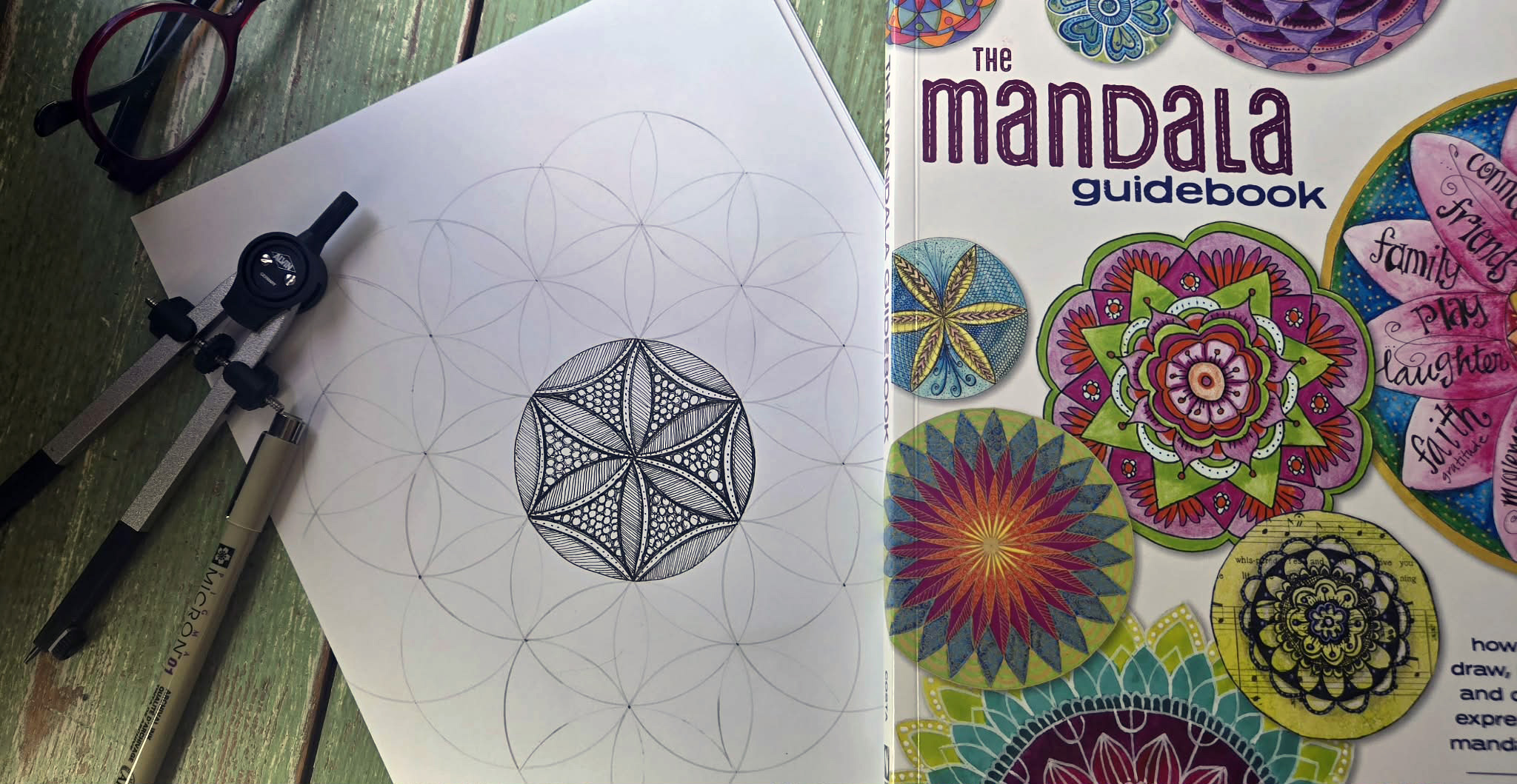
Want to learn how to draw mandalas? Check out my book, “The Mandala Guidebook.”



Leave a Reply